Solar System Bingo Cards (Free Printable Generator)
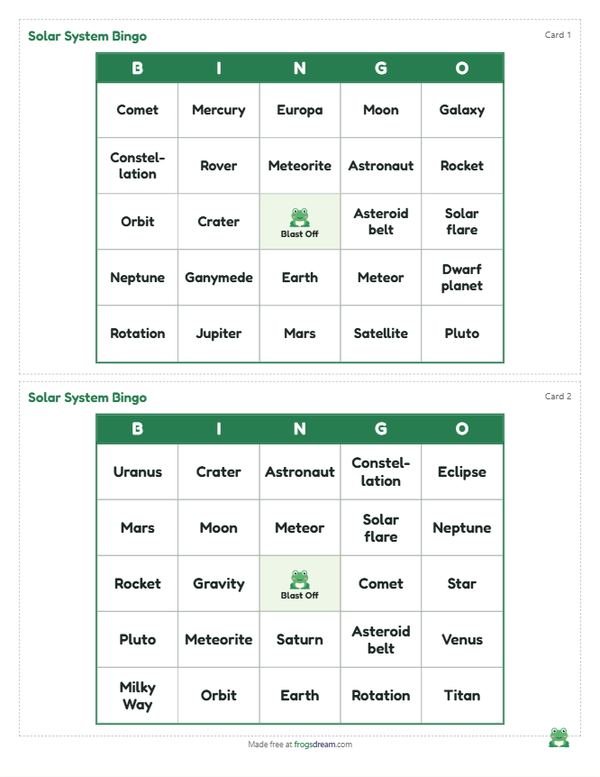
Print free solar system bingo cards with planets, moons and space words for a science lesson or a space party. The list has 36 terms in plain language for ages six and up.
Loading your preview...
Need 40 ready-made cards for every theme, plus caller sheets, in one download? Get the Mega Pack
The word list
Planets in order from the sun come first, then moons, then space words. Pluto sits on the list as a dwarf planet, which sparks good conversation about how scientists group worlds.
- Sun
- Mercury
- Venus
- Earth
- Mars
- Jupiter
- Saturn
- Uranus
- Neptune
- Pluto
- Moon
- Phobos
- Europa
- Titan
- Ganymede
- Asteroid belt
- Comet
- Meteor
- Meteorite
- Crater
- Orbit
- Rotation
- Gravity
- Galaxy
- Milky Way
- Star
- Constellation
- Telescope
- Astronaut
- Rocket
- Space station
- Satellite
- Rover
- Solar flare
- Eclipse
- Dwarf planet
How to play solar system bingo
Space bingo works as a unit review or as a full-class activity on a rainy day. Before you start, hang a poster of the planets within view so children can check their cards against it.
- Hand out cards and markers. Round stickers or counters look like little planets.
- The caller draws a term and reads a clue rather than the word, such as the biggest planet.
- Players who can name the answer cover the square.
- Anyone who reaches a line says the names of all squares in it.
- Play a second round with different clues for students who need practice.
Three variations out of this world
- Planet order race. Instead of squares, give each team the eight planets to arrange in order from the sun, then bingo from there.
- Mission round. Use only the spacecraft and people squares, such as rover, satellite and astronaut, with questions about what each does.
- Night sky outing. On a clear evening, cover squares for things you can actually see, like the moon, a star, a satellite or a constellation.
Tips for science teachers
Offer two levels of clues. Younger students can hear simple descriptions, while older students get measurement or distance facts.
Check facts against NASA's solar system pages at science.nasa.gov/solar-system when you write your clues.
Keep a quiet corner for kids who find the vocabulary hard. Pair them with a reading buddy.
Printing for the space theme
Dark blue paper does not print well, so choose light paper and decorate with star stickers. Ink saver keeps big words legible on the card.
Print a list of the answers for helpers. Cutting the page in two lets you give each team a card and keep the other half as a caller sheet.
FAQ
Is Pluto still on the list?
Yes, as a dwarf planet. Scientists now call it that, so the card is a chance to talk about why.
What grade level is this for?
It suits grades one through five. Younger children can use planet names only, and older ones can handle the vocabulary squares.
Can I use it for a space party?
Yes. Add a rocket craft and moon snacks, then play for half an hour with prizes from the party bag.