
Behavior Chart for Kids (Free Printable)
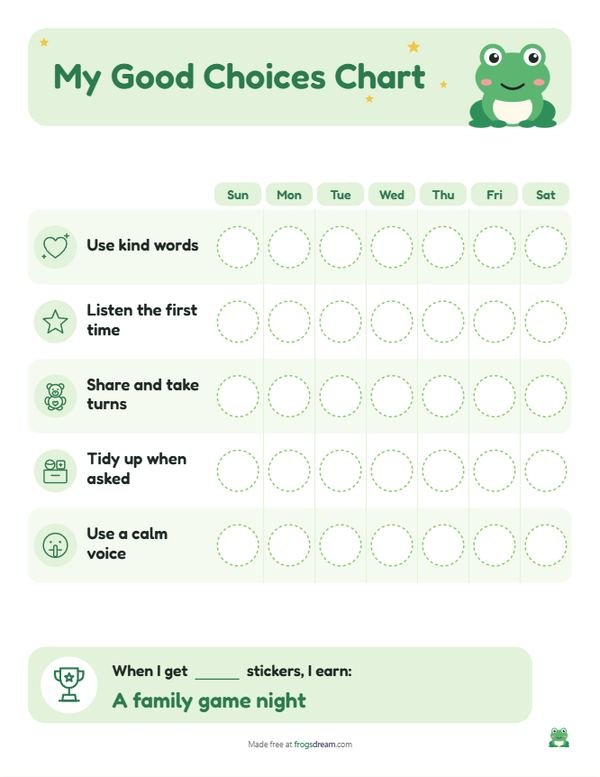
This behavior chart focuses on what you want to see, not what you want to stop. Five positive goals, a row of stickers or ticks each day, and a small prize at the end of the week.
Loading your preview...
Want ready-made reward, chore and potty charts in four soft colors? Get the Mega Pack
The chart tasks
Every goal is something to do, not something to avoid. Choose the one or two that matter most this month and delete the rest, because a child can only work on so many things at once.
- Use kind words
- Listen the first time
- Share and take turns
- Tidy up when asked
- Use a calm voice
Using a behavior chart in a positive way
A behavior chart works when the child knows exactly what earns a mark. Vague goals such as 'be good' leave room for disagreement, so each row here names a specific action.
- Talk to your child before you print. Say what you hope to see more of and ask what they think would be fair.
- Choose two or three goals to start with. Delete the rest of the rows for now.
- Decide when marks are given, for example at dinner and at bedtime, and stick to it.
- Give the sticker with a short comment: 'You took turns with the blocks.' Specific praise teaches more than the sticker.
- At the end of the week, count together and have the prize. Then talk about which goal to change.
Different ways to use the chart
- One goal focus. Keep a single row for a month if there is one stubborn problem, like interrupting. A narrow chart gets results.
- Morning and afternoon marks. Divide the day in two and give a mark for each half, so a rough morning does not spoil the whole day.
- Sibling team. Print one chart with a shared goal so siblings cheer each other on rather than compete.
Tips for parents and teachers
Never take a mark away for a bad moment. The chart is for catching good behavior, and removing marks makes children stop caring about it.
Give the mark as soon as possible after the behavior. A sticker at the end of the day for something that happened at breakfast is much less powerful.
Be consistent for at least a few weeks before judging whether the chart works. New systems usually take time to settle.
A chart is a tool, not a cure. If behavior worries you, speak to your child's teacher or pediatrician about extra support.
These are general parenting ideas, not psychological or medical advice.
Printing and displaying the chart
Print in color on regular paper for the first week to see whether it catches interest. If it works, move to cardstock or laminate it. Hang it at the child's eye level, not the adult's, in a place where visitors will not read it, since a behavior chart is personal. Tick boxes work well in the classroom and stickers suit the home. Choose black and white when you plan to print several copies for a classroom.
FAQ
What age is a behavior chart for?
Charts are usually most effective for children from about three to eight. Younger children need immediate rewards and older children usually do better with a shared agreement.
Should I use punishments with a behavior chart?
This chart is designed for rewards only. Taking marks away tends to discourage children from trying. Use other, calm consequences separately.
How many behaviors can I track at once?
Two or three is easiest. The chart allows more, but children focus better on a few clear goals.