Polar and Arctic Animals Word Search (Free Printable Puzzle)
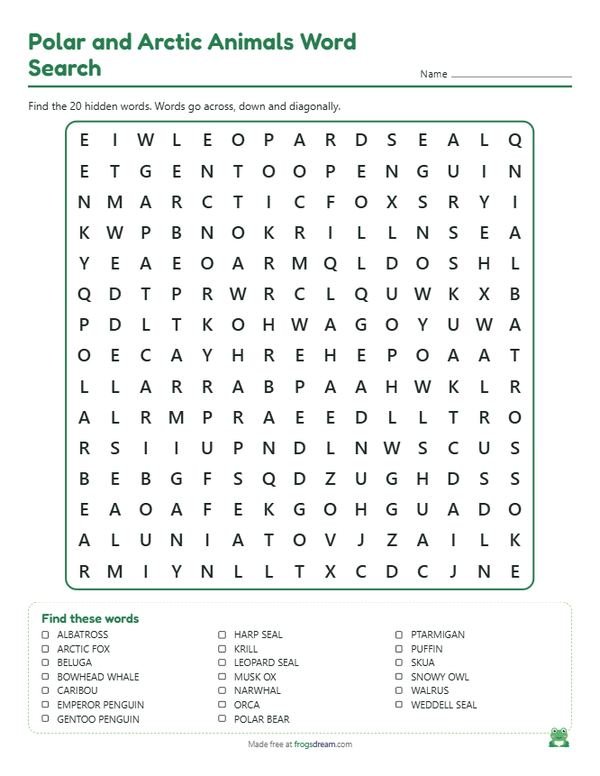
This free polar animals word search hides 20 creatures from both ends of the earth: twelve from the Arctic in the north, seven from Antarctica and the Southern Ocean, and the orca, which swims at both poles. It fits a winter science unit for grades two to six.
Loading your preview...
Want all 50 word searches at two levels, each with an answer key, in one download? Get the Mega Pack
The word list
The first twelve animals live in the Arctic and the next seven in Antarctic waters. The orca is the one animal here found at both poles.
- Polar bear
- Arctic fox
- Walrus
- Narwhal
- Beluga
- Musk ox
- Caribou
- Snowy owl
- Puffin
- Ptarmigan
- Harp seal
- Bowhead whale
- Emperor penguin
- Gentoo penguin
- Leopard seal
- Weddell seal
- Krill
- Albatross
- Skua
- Orca
Using the puzzle in a polar unit
Children often picture penguins and polar bears side by side, but they live about as far apart as two animals can. This puzzle is a chance to fix that idea while students hunt for letters.
- Print the puzzle and, before anyone starts, ask the class to guess which animals live in the north and which in the south.
- Solvers circle the 20 words, then sort them into two columns on the back: Arctic and Antarctic.
- Reveal the answer: the list above puts the Arctic animals first and the Antarctic animals after them, with the orca at the end because it swims in both.
- Finish with one fact per animal from a library book or a trusted website.
Penguins are found only in the Southern Hemisphere, as the Australian Antarctic Program explains, while NOAA Fisheries describes the narwhal as an animal of the Arctic Ocean. Those two facts alone settle most classroom debates.
Classroom variations
- North or south. Call out an animal and have students point up for the Arctic or down for Antarctica. The orca gets both hands.
- Adaptation match. After solving, pair each animal with one adaptation, such as the white winter coat of the arctic fox or the layer of blubber on a Weddell seal.
- Food web. Krill feeds whales, seals and penguins in the Southern Ocean. Have students draw arrows from krill to the animals it supports.
- Easy grid. For first and second grade, keep only the short names like walrus, puffin, krill, orca and beluga, and switch to a small easy grid.
Tips for teachers
Two-word names keep their space in the word list but run together in the grid, so remind solvers that polar bear appears as POLARBEAR.
The caribou and the reindeer are the same species. In North America the wild animal is called caribou, and reindeer usually means the domesticated herds of Europe and Asia.
If you print several copies, each puzzle has its own letter layout, which helps when desks are close together.
Printing notes
White paper and dark ink keep the grid readable. One puzzle fits a page with the word list underneath, and the key prints separately. For a bulletin board, make a large grid and pin up a map of both poles beside it so students can place each animal.
FAQ
Do polar bears and penguins ever meet?
Not in the wild. Polar bears live around the Arctic Ocean in the north, and penguins live only in the Southern Hemisphere, with the biggest colonies on Antarctic coasts.
Which animals on the list live near the South Pole?
Emperor and gentoo penguins, leopard and Weddell seals, krill, albatrosses and skuas. Orcas visit Antarctic waters too, but also the Arctic and every ocean in between.
What age is this word search for?
The full list suits grades three to six. Younger children can use a shorter list with the easy setting, where words run only left to right and top to bottom.