
Kwanzaa Bingo Cards (Free Printable Generator)
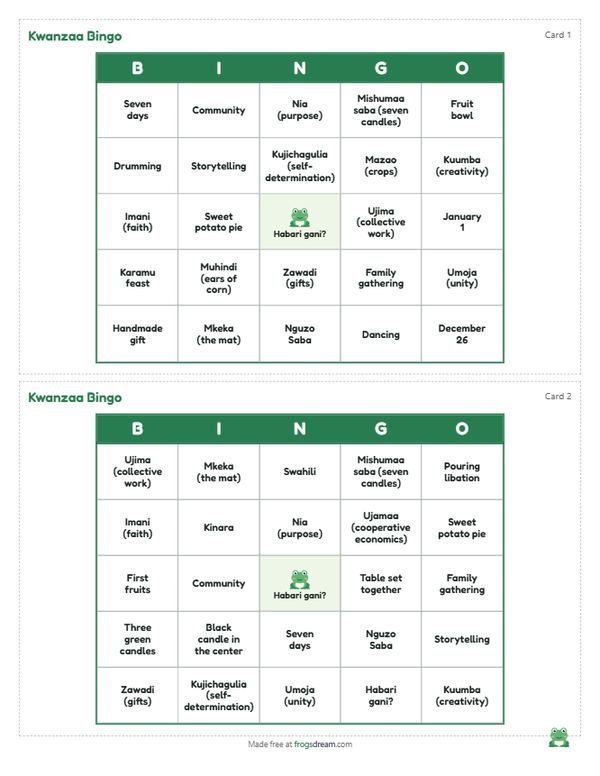
Print free Kwanzaa bingo cards built around the seven principles, the seven symbols and the daily customs of the celebration. The list pairs each Swahili term with its English meaning, so a classroom new to Kwanzaa can play and learn at the same time.
Loading your preview...
Need 40 ready-made cards for every theme, plus caller sheets, in one download? Get the Mega Pack
The word list
Every Swahili term carries its English meaning in parentheses, so players can match the call even if the word is new to them. Shorten a square to just the Swahili word once the class knows the vocabulary.
- Umoja (unity)
- Kujichagulia (self-determination)
- Ujima (collective work)
- Ujamaa (cooperative economics)
- Nia (purpose)
- Kuumba (creativity)
- Imani (faith)
- Nguzo Saba
- Kinara
- Mishumaa saba (seven candles)
- Black candle in the center
- Three red candles
- Three green candles
- Mkeka (the mat)
- Mazao (crops)
- Muhindi (ears of corn)
- Kikombe cha umoja (unity cup)
- Zawadi (gifts)
- Karamu feast
- Habari gani?
- First fruits
- Harvest
- December 26
- January 1
- Lighting a candle
- Pouring libation
- Honoring ancestors
- Family gathering
- Community
- Storytelling
- Drumming
- Dancing
- Handmade gift
- A new book
- Fruit bowl
- Sweet potato pie
- Bendera (the flag)
- Swahili
- Seven days
- Table set together
How to play Kwanzaa bingo
Kwanzaa runs from December 26 to January 1, and each of the seven days is given to one principle. Dr. Maulana Karenga created the celebration in 1966, and his official Kwanzaa website describes it as a cultural holiday rather than a religious one, rooted in African first-fruits harvest festivals. That makes it a good fit for a public school unit on winter celebrations, a library program or a family evening.
- Print one card per player and gather markers such as dried beans, kernels of corn or small squares of red, black and green paper.
- Before the first call, read the seven principles aloud and let players repeat the Swahili words.
- Call squares from the list. Say the Swahili word first, pause, then give the English meaning so everyone can find it.
- The first player to fill a line calls out the day's principle, for example "Umoja!" on the first day.
- For a longer game, play for a full card, which gives time to talk about each symbol as it is called.
Ways to adapt the game
- One principle a day. Over the week, play a short round each evening and keep only squares that connect to that day's principle, plus the symbols on the table.
- Classroom quiz round. The caller reads only the English meaning, and players must find the Swahili square. Flip it for a harder round.
- Community event. At a cultural center or a church hall, set cards on every table so grandparents and children play side by side while the karamu is being prepared.
- Symbol hunt. Before bingo, lay out a real mkeka, kinara, cup and ears of corn. Players point to the object when its square is called.
Tips for teachers and hosts
Teach the greeting first. "Habari gani?" means "What's the news?" in Swahili, and the answer each day is that day's principle: Umoja, Kujichagulia, Ujima, Ujamaa, Nia, Kuumba and Imani. Using it as the free square keeps it in front of everyone.
Describe the holiday plainly and let families who observe it speak for their own traditions. Some households light the kinara and share a meal quietly; others hold a large karamu, usually on December 31, with music, dancing and remembrance of ancestors. Neither way is more correct.
Say the words with care. A quick pronunciation guide on the board helps: oo-MO-jah, koo-jee-chah-goo-LEE-ah, oo-JEE-mah, oo-JAH-mah, NEE-ah, koo-OOM-bah, ee-MAH-nee.
Printing the cards
The Swahili squares are longer than most bingo words, so the 5 by 5 grid at two cards per page keeps the text readable. Choose one card per page for younger children or for anyone who prefers large print.
Red, black and green are the colors of the bendera, the flag used during Kwanzaa. Plain white paper with markers in those three colors looks festive without using much ink. Ink saver mode is on by default.
FAQ
Is Kwanzaa bingo appropriate for a public school classroom?
Yes. Kwanzaa is a cultural celebration of African American heritage, family and community, not a religious observance, and the game simply teaches its vocabulary and symbols. Many teachers pair it with Hanukkah and Christmas activities in a winter holidays unit.
Are the Swahili spellings correct?
The terms follow the official Kwanzaa website maintained by the holiday's founder. You may see muhindi written as vibunzi (the plural form) elsewhere, and both are used. Edit any square in the list box if your community prefers a different form.
Can I play without the English meanings?
Yes. Delete the parentheses from each square in the list and generate again. Keep a printed copy of the full list for the caller so the meanings can still be announced.