Winter Holidays Around the World Word Scramble (Free Printable)
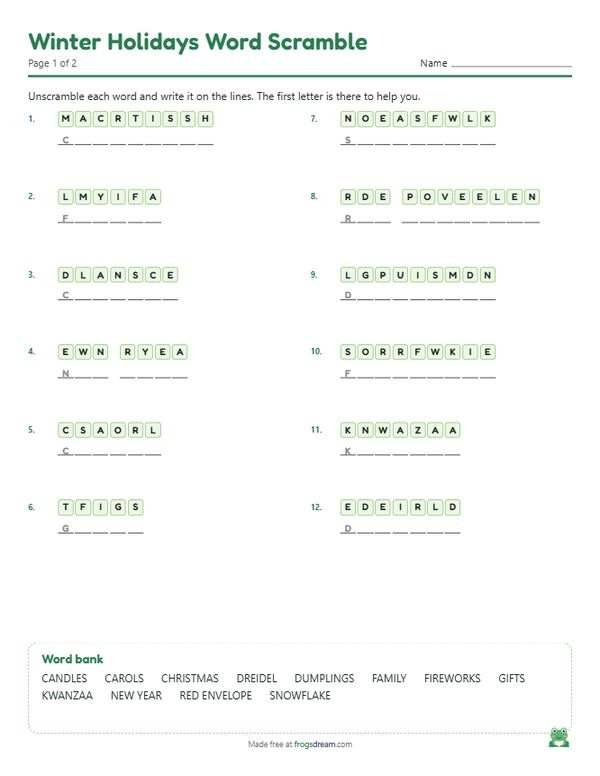
Print a free word scramble that mixes 24 words from the celebrations that fall between December and February: Christmas, Hanukkah, Kwanzaa, New Year's Eve, Lunar New Year and the winter solstice. It is written for public school classrooms where every family's tradition deserves a place.
Loading your preview...
Want all 15 word scrambles with hint versions and answer keys in one download? Get the Mega Pack
The word list
Every word is a plain noun or verb that belongs to at least one of the celebrations, with nothing religious to explain beyond the holiday names themselves. Swap in a word from a tradition your students bring to class.
- Christmas
- Hanukkah
- Kwanzaa
- New Year
- Lunar New Year
- Solstice
- Menorah
- Kinara
- Dreidel
- Lantern
- Red envelope
- Fireworks
- Candles
- Carols
- Feast
- Dumplings
- Gifts
- Family
- Tradition
- Celebrate
- Countdown
- Snowflake
- Longest night
- Festival
How to use the winter holidays word scramble
December classrooms hold children who light a menorah, children who wait for Christmas morning, children whose families gather for Kwanzaa or for Lunar New Year, and children who celebrate none of these. One scramble that draws on all of them lets the whole class work on the same sheet without anyone's holiday being the odd one out.
- Print the sheet with the word bank on, since several words will be new to most students.
- Before solving, read the bank aloud and ask who can say which celebration each word belongs to. Many belong to more than one.
- Give ten minutes to unscramble, then check against the answer key together.
- Close by letting volunteers share one thing their family does in winter, holiday or not.
Variations for the classroom
- Sort the answers. After solving, students copy each word under a heading: Christmas, Hanukkah, Kwanzaa, New Year, Lunar New Year, Solstice or More than one.
- Calendar line. Put the holiday names in date order along a string across the room, from the solstice in late December to Lunar New Year in late January or February.
- Research pairs. Each pair picks one unscrambled word and writes two sentences about it for a class booklet.
- Younger version. Keep the twelve shortest words and leave the first letter hint on.
Facts to have ready
A few facts help you answer questions as they come up. Hanukkah lasts eight nights and begins on the 25th of Kislev, so its dates shift against the regular calendar. Kwanzaa was created in 1966 and runs from December 26 to January 1, with one principle for each of its seven days, as explained on the official Kwanzaa website. The winter solstice, the shortest day of the year in the Northern Hemisphere, falls on December 21 or 22, and Lunar New Year arrives in late January or February and is celebrated in China, Vietnam, Korea and by communities around the world, often with red envelopes, lanterns, fireworks and a family dinner (see the Wikipedia articles on the winter solstice and Lunar New Year).
Keep the tone descriptive. Say what people do and when, and let students who observe a holiday add their own detail if they want to.
Our separate Hanukkah scramble and Kwanzaa word search go deeper into one tradition each, if your unit spends a day on each holiday.
Printing tips
One puzzle fits a single letter or A4 page, and the answer key prints on a separate sheet. White paper keeps every color of the season neutral. Set puzzles to the number of students, up to 10 at a time, so neighbors get different letter orders.
FAQ
Is this word scramble suitable for a public school?
Yes. It names holidays and the objects and customs linked to them, in the same way a social studies lesson would, and it includes a non-religious celebration, the solstice, as well as New Year.
Why is Lunar New Year included in a winter list?
It falls in late January or February, which is still winter in the Northern Hemisphere, and many students celebrate it. Leaving it out would miss a holiday that millions of families observe.
Can I add holidays that are missing?
Yes. Type extra words into the generator, such as a dish or an object from a celebration in your classroom, and the puzzle and key rebuild at once. The list takes up to 30 words.