
Gardening Word Search (Free Printable for All Ages)
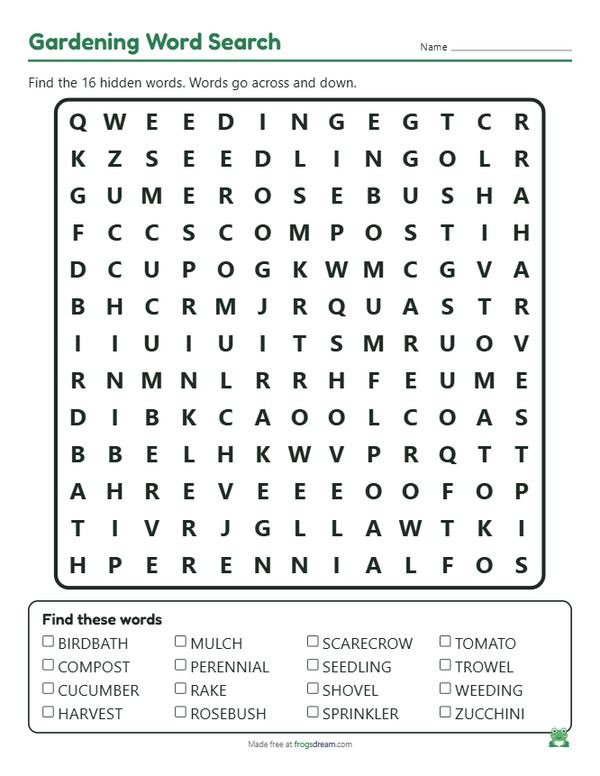
Print a free gardening word search with 16 words about tools, vegetables and the work of a growing season. Large print is switched on and the words only run forward and down, so it suits senior activity groups and children alike.
Loading your preview...
Want all 50 word searches at two levels, each with an answer key, in one download? Get the Mega Pack
The word list
Sixteen words from the tool shed and the vegetable patch, none longer than nine letters, so the grid stays small and the letters big. Add what grows in your own beds, or longer words like wheelbarrow and greenhouse if your group reads fine print.
- Trowel
- Compost
- Mulch
- Seedling
- Tomato
- Cucumber
- Zucchini
- Rake
- Shovel
- Sprinkler
- Perennial
- Rosebush
- Harvest
- Weeding
- Scarecrow
- Birdbath
Bringing the garden indoors
Gardening is the hobby that most residents of a senior community kept the longest, and it is one children take to as soon as they are handed a trowel. This puzzle is a quiet companion to the real thing: do it at the table on a rainy day, or on the patio while the beans come up.
- Print a copy for each person and a spare for the table. Felt pens or soft pencils are easiest to see.
- Read the list aloud. In a senior group, stop at a few words and ask about them: who grew tomatoes, who had a scarecrow, who hated weeding.
- Let everyone search at their own pace. Ten to fifteen minutes is usually enough with the easy setting.
- Go over the answers together. Then, if you can, walk out to the raised beds and find the real trowel, rake and seedlings.
In a classroom, the puzzle fits a plant unit or a school garden day. Children can sort the words into tools, plants and jobs before they start.
Other ways to use the list
- Seed packet puzzle. Replace the vegetables with whatever your group is planting this year, print the puzzle, and tuck a copy into each resident's gardening folder.
- Grandparent and grandchild. Print two copies. The grandparent explains each word while the child circles it. Both finish the puzzle and the child learns what a trellis is.
- Garden club quiz. After the puzzle, ask the table to explain the difference between compost and mulch, or between pruning and weeding. The answers start a lively discussion.
- Harvest season. Add the names of what was picked this week and generate a fresh puzzle to celebrate it.
Tips for seniors, families and teachers
For residents with low vision, keep the grid at 13 by 13 or smaller and remove the longest words. Capital letters, the easy setting and the Large print box, which enlarges the grid letters and the word list, are all already set on this page.
Some residents gardened for a living on farms or in nurseries, and they know far more than the activity leader. Ask them to lead the conversation about the words; it is a gift to be the expert in the room.
With children, pair the puzzle with planting a bean in a cup. The words become real as the seedling appears and the first weeding is needed.
A word search is a calm activity for a resident who is anxious or restless. Sit alongside, read the words quietly, and let them circle at their own speed. Finishing does not matter.
Printing tips
Print on plain white paper for the clearest letters. If the sun on a patio causes glare, cream paper is a little kinder to the eyes.
Make several puzzles in one go by raising the Puzzles number. Each has the same words in a new layout, so a weekly gardening group gets a different page every time.
Keep the answer key with the leader. The generator prints it on its own page.
FAQ
Who is this gardening word search for?
Anyone who likes a garden. Senior centers and assisted living groups use it as a large print puzzle, garden clubs use it as a warm-up, and teachers and parents use it with children in a plant unit or at a school garden.
Why is the word list different from the plants and flowers puzzle?
That puzzle is about the parts of a plant and flower names, for a science lesson. This one is about the work of gardening: tools, vegetables and jobs like pruning and weeding. The two make a good pair.
Can I make the letters bigger?
Yes. Remove the longest words from the list, such as sprinkler, perennial and scarecrow, then set the grid to 10 or 11. Fewer letters across the page means each one prints larger, and the Large print box keeps the word list at 16 point.