ESL Body Parts Bingo Cards (Free Printable Generator)
Print free body parts bingo cards for English learners with 32 words from head to toe. Each card is different, and every word can be shown with a point or a tap, so no pictures are needed.
Loading your preview...
Need 40 ready-made cards for every theme, plus caller sheets, in one download? Get the Mega Pack
The word list
The list runs from the top of the head down to the toes, in the order most teachers introduce the words. Pairs appear in the plural (eyes, ears, fingers) and single parts in the singular, which mirrors how learners will use them in sentences.
- head
- hair
- face
- forehead
- eyebrows
- eyes
- ears
- nose
- cheeks
- mouth
- lips
- teeth
- tongue
- chin
- neck
- shoulders
- chest
- back
- stomach
- arm
- elbow
- wrist
- hand
- fingers
- thumb
- leg
- knee
- ankle
- foot
- toes
- heel
- skin
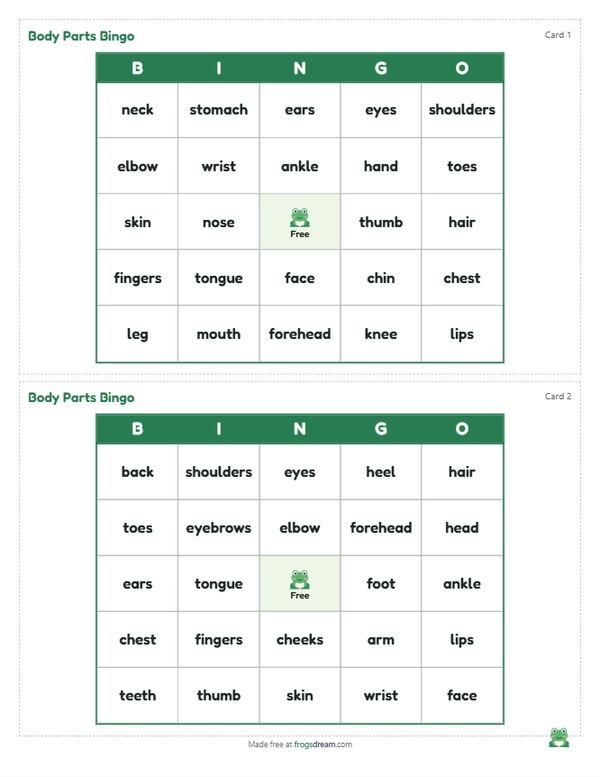
Body parts bingo, taught with the body you came in with
No topic is simpler to demonstrate. Every word on this card can be shown by touching it, which means pre-readers and brand new learners can play on the first day, and adults get a lively break from the textbook. The game also sets up the health and doctor vocabulary that follows in most courses.
- Warm up with a touch routine: say a word, touch the part, and let the class copy. Speed up as they get confident.
- Pass out cards and counters.
- Call a word in one of three ways: say it, touch the part in silence, or point to it on a figure drawn on the board. Mixing the three keeps everyone listening and watching.
- Learners cover the word and touch the matching part of their own body.
- A complete line ends the round. The winner reads the line while the class touches each part together.
- Trade cards and play again with silent calls only.
Online, the camera does the work. Touch your nose, your learners find the word, and the bingo caller on a shared screen shows the spelling after a short pause so they can check themselves.
Variations with movement and speaking
- Sentence to cover. Learners must say a sentence before covering: "I have two ears" or "My knee hurts." The second pattern leads straight into the doctor's visit lesson.
- Simon says bingo. Give a command such as "Touch your elbow." Only learners who follow it correctly may cover the square. Add a wrong command now and then to keep them sharp.
- Count it. After each call, the class says how many of that part a person has: "one nose, ten fingers." Numbers and plurals get a workout together.
- Monster draw. The winner invents a creature with unusual numbers of parts ("three eyes, one leg") and the class draws it. Children adore this, and adults find it funnier than they expect.
Teaching notes for body vocabulary
Start small with the youngest learners. Head, eyes, ears, nose, mouth, hands and feet are enough for a first round on a 3x3 grid, and most of them already know a song that uses those words. Adult beginners can take the whole list and will appreciate it the next time they need to explain an ache to a pharmacist.
The irregular plurals are the hidden grammar here. Foot and feet, tooth and teeth catch everyone out, and it helps to call both forms during the game so learners hear them in context.
Keep the touching to each learner's own body, and let anyone who prefers to point at the board figure do so. Some learners feel shy about words like stomach or chest; a plain, matter-of-fact tone from you makes those squares ordinary.
A quick follow-up
Hand each learner a blank outline of a person and ask them to label eight parts from their card. Children color it in; adults add "My ___ hurts" sentences underneath. Pin the sheets up and the room has its own picture dictionary for the rest of the unit.
Printing body parts cards
Short words print large, so even the four per page setting stays readable for older learners. Use one card per page for pre-readers who will draw beside the words. Cardstock and a laminating pouch keep a set in service for years, and ink saver gives a plain black grid for school copiers. Pick Letter or A4 to match your paper.
FAQ
Can non-readers play body parts bingo?
Yes. Call by touching, and let them match your movement to your spoken word before they look for it on the card. The reading comes along slowly as the same words appear round after round.
Why are some words plural and others singular?
The card shows each word the way learners use it most. People have two eyes and ten fingers but one nose, so the plural forms are natural for pairs and the singular for single parts.
Is there anything on the list I should remove for a mixed adult class?
The 32 words are the everyday parts a doctor or coach would name, nothing private. Still, you can delete any word in the list above and the cards update at once.
How does this connect to a health lesson?
After the game, add the pattern "My ___ hurts" and let learners role-play a visit to the doctor using words from their card. The vocabulary is already warm, so the role play goes quickly.