
ESL Family Bingo Cards (Free Printable Generator)
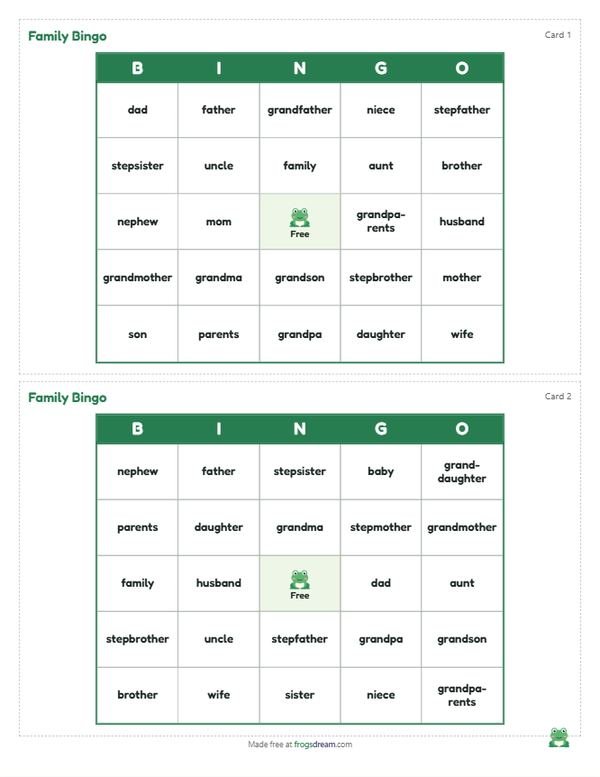
Print free family bingo cards for English learners with 30 words for the people at home, from mom and dad to cousins and grandparents. Every card is different, and the list is easy to adjust for the families in your class.
Loading your preview...
Need 40 ready-made cards for every theme, plus caller sheets, in one download? Get the Mega Pack
The word list
Both the formal words and the ones children actually say are here, so mother sits next to mom and grandfather next to grandpa. Families come in many shapes, and the list bends to fit them: delete what you do not need, and type in words such as guardian, foster mom or two dads when a learner needs them.
- mother
- father
- mom
- dad
- parents
- sister
- brother
- baby
- twins
- grandmother
- grandfather
- grandma
- grandpa
- grandparents
- grandson
- granddaughter
- aunt
- uncle
- cousin
- niece
- nephew
- son
- daughter
- husband
- wife
- stepmother
- stepfather
- stepsister
- stepbrother
- family
Playing family bingo without putting anyone on the spot
Family words come early in every course because learners want to talk about the people they love. The same words can also touch a nerve, so the game below is built around a made-up family on the board rather than each learner's own. Learners can bring in their real families later, when they choose to.
- Draw a quick family tree on the board with stick figures and give them names. Point to each one and say the word: "This is Anna. She is the mother."
- Hand out cards and counters. Paper hearts cut from scrap are a cheerful fit.
- Call a word, or point to a figure on the tree and let the class name it, or give a clue: "My mother's sister."
- Learners cover the word and say it back to a partner.
- The first finished line wins. The winner reads the words and points to the matching figures on the board.
- Shuffle cards between learners and run a second round using clues only.
Over video, the family tree lives on a shared whiteboard and the cards go out as PDFs or pictures before the lesson. Learners mark squares on paper or with a drawing tool, and the bingo caller shows each word in big letters.
Variations that build sentences
- Who is who. No square is covered until the learner says a sentence about the figure on the board: "Tom is Anna's brother." It drills possessives without a worksheet.
- Two-step clues. Call relationships instead of words: "Your father's mother." The class works out grandmother, then covers. Good for stronger groups.
- Photo talk. Learners who want to can bring one family photo, or a picture of a famous cartoon family, and describe three people on it using words from the card.
- Older or younger. After each call, learners say whether the person is usually older or younger than a child: "A grandfather is older." It adds comparatives in a natural way.
Teaching notes and sensitivities
Keep the imaginary family in the center. Some learners live with one parent, with grandparents, in a blended family or far from their relatives, and a game that keeps asking "What about your father?" can quietly exclude them. When learners volunteer their own families, welcome it; when they do not, the board family carries the lesson.
Young learners should start with mom, dad, sister, brother, baby, grandma and grandpa on a 3x3 grid. Adult beginners can take the whole list and often want extra words for their own situation, such as partner, in-laws or ex-husband. Add them when asked.
Two sound points: learners from many backgrounds struggle with the th at the start of the formal words, and nephew is often misread with a hard p. Model both before the first round.
After the game
Each learner draws a small family tree for an invented or real family and labels it with six words from the card. Children can draw faces; adults can write a sentence under each name. It gives you a quick written check of the vocabulary.
Printing family cards
Print two cards on a page for a group and one per page for a tutoring session, where the extra space suits a tiny sketch beside each word. A laminated set and a dry-erase marker last a whole term. Turn on ink saver for a plain black grid, and pick Letter or A4 in the options to match your printer.
FAQ
How do I handle learners who have lost a parent or live in care?
Build the game around the invented family on the board and never require personal answers. Most learners join in happily with a fictional family, and those who want to share will do so in their own time.
Should I teach mom or mother first?
Teach both, because learners will hear both. Mom and dad are what children say, while mother and father appear on forms and in stories. Having them side by side on the card makes the pair clear.
Can I add words for other family shapes?
Yes. Type in anything your learners need, such as guardian, foster parent, half sister or godmother, and the cards rebuild at once. You can also tighten the list to the few words a young class is learning.
Is this list suitable for adult beginners?
It is. Adults learning English for work or immigration meet these words on official forms and in everyday small talk, and the clue-based round gives them a real listening task.