
ESL Jobs Bingo Cards (Free Printable Generator)
Print free jobs bingo cards for English learners with 32 occupations, from teacher and farmer to astronaut and zookeeper. Every job word is gender-neutral, so one list fits the whole class.
Loading your preview...
Need 40 ready-made cards for every theme, plus caller sheets, in one download? Get the Mega Pack
The word list
Every word here names the job without saying who does it. Firefighter, police officer, mail carrier and server replace the older forms some course books still print, so learners pick up the words they will actually hear at work and in the news. Add the jobs your learners' families do.
- teacher
- doctor
- nurse
- dentist
- vet
- firefighter
- police officer
- mail carrier
- farmer
- chef
- baker
- server
- bus driver
- taxi driver
- pilot
- mechanic
- builder
- plumber
- electrician
- librarian
- scientist
- artist
- singer
- dancer
- actor
- photographer
- hairdresser
- cashier
- gardener
- lifeguard
- astronaut
- zookeeper
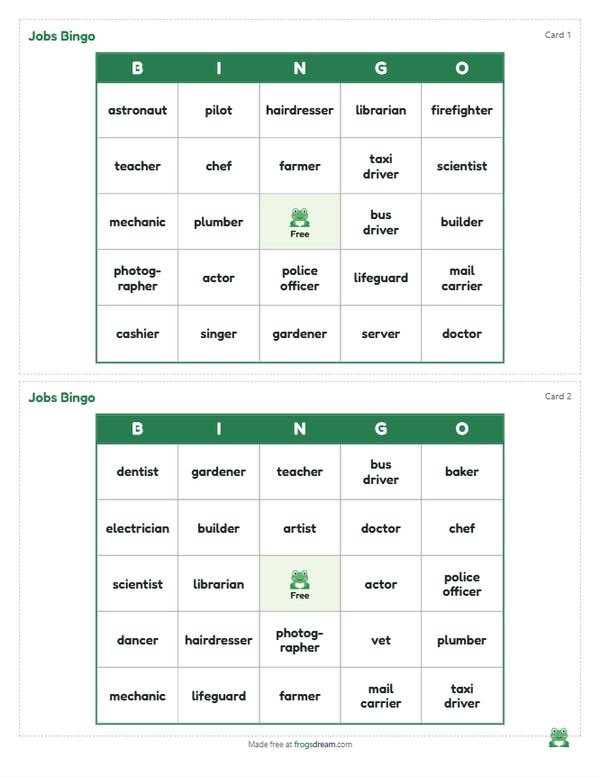
Running jobs bingo with mime, props and pictures
Jobs are a topic with a built-in speaking goal. Sooner or later every learner wants to say what they do, what their parents do or what they hope to become, and the nouns on this card are the bricks for those sentences. Bingo lets the class hear each one a dozen times before anyone has to produce it under pressure. A round on a 5x5 card takes roughly ten minutes.
- Show the jobs before you play. A hat, a stethoscope, a whisk or a toy fire truck works as a prop, and a quick sketch on the board is fine when your bag is empty.
- Give every learner a card and something to cover squares with. Coins, paper clips and bottle caps all serve.
- Call the job in one of three ways: say it plainly, act it out in silence, or hold up a picture and wait. Vary the method so listening, watching and reading all get a turn.
- Learners who have the word cover it and say the job quietly to a neighbor.
- The first complete line wins. The winner names every covered job while you tick them on the caller sheet.
- Before the next round, ask the winner one question: "Which of these jobs would you like? Why?"
Online, the same routine works over a shared screen. Send each learner a card as a PDF, mime into the camera, and let them mark squares on paper or with a drawing tool. Our bingo caller can load this list and show each call in large type.
Variations that get learners talking
- Sentence first. Nobody may cover a square until they have said one sentence with the word: "A baker makes bread" or "My uncle is a mechanic." Keep the bar low for beginners.
- Where do they work? Call a place instead of a job: "hospital", "kitchen", "airport". Learners cover a job that fits and justify the choice. Several answers can be right, which starts a useful discussion.
- What do they use? Name a tool, such as a ladder, a camera or a hose, and the class works out the job. The guessing adds vocabulary around the core word.
- Interview the winner. The learner who wins picks one job from the card and answers three questions from the class in role. Shy groups can do it in pairs.
Tips for teaching job words well
Young learners enjoy the mime far more than the reading, so lean on it. Let them perform the job for the class after each call, and the word arrives with a movement attached. Adults care most about the jobs that match their own lives, so ask them early which words to add.
Point out that English does not change most job words for men and women. Learners whose first language has two forms sometimes ask about actress or waitress; explain that actor and server are used for everyone now.
A few of these words hide pronunciation traps. Learners often stress the wrong syllable in photographer and mechanic, and the ending of scientist gets swallowed. Model those three slowly, and keep the tone respectful: every job on the list matters, and children notice when a teacher says so.
Linking the game to real speaking
Finish with a two-minute survey. Each learner asks three classmates "What do you want to be?" and notes the answers. Adults can swap in "What do you do?" and practice the small talk that goes with it. The card stays in front of them as a word bank, so nobody is stuck for a noun.
Printing jobs cards for class and tutoring
Two cards on a page is the right setting for a class of twenty or more; cut the sheets in half and you need only half the paper. Private tutors tend to prefer one large card per page with room for the learner to doodle a picture beside each job.
Thicker paper or a laminating pouch turns a set into a term-long resource, and a dry-erase marker replaces loose counters. Ink saver mode gives a clean black outline for the school copier. Choose A4 or Letter in the options.
FAQ
Which jobs should I remove for very young learners?
Keep the ones children can act out or see in their street: teacher, doctor, firefighter, farmer, baker, bus driver, police officer. Save plumber, electrician and scientist for a later unit, and shrink the grid to 3x3.
Why does the list say server and mail carrier instead of waiter and mailman?
Those forms work for anyone, and they are what learners will hear in American workplaces. If your course book uses waiter, type it into the list and both forms can appear on the cards.
Can I use these cards for a careers lesson with teenagers?
Yes. Ask them to sort the covered jobs by where you work, what you wear or how long you study, then present one job to the class. The sorting gives them something to say.
How do I play when my learners are online in different places?
Share your screen with the caller or hold up pictures to the camera, and send each learner a different card beforehand. They tick squares on paper or draw on the image, and read their line aloud when they win.