
Holiday Traditions Around the World Bingo Cards (Free Printable)
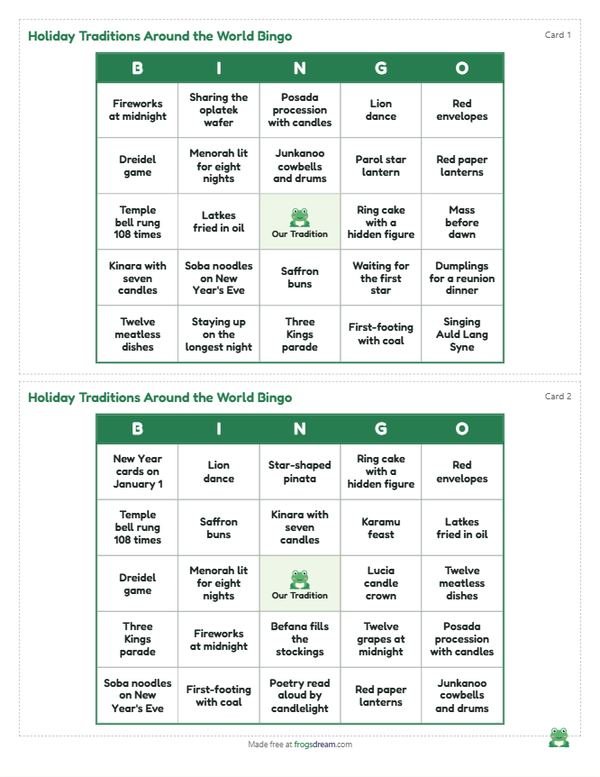
Print free bingo cards built from 32 real winter traditions around the world, from Hanukkah candles to parol lanterns in the Philippines. Every square is explained below, with sources.
Loading your preview...
Need 40 ready-made cards for every theme, plus caller sheets, in one download? Get the Mega Pack
The word list
Each square names one custom, and the section below says where it comes from and when it happens. Take out any you do not want to explain, or add your own family's.
- Menorah lit for eight nights
- Dreidel game
- Latkes fried in oil
- Kinara with seven candles
- Karamu feast
- Posada procession with candles
- Star-shaped pinata
- Lucia candle crown
- Saffron buns
- Twelve grapes at midnight
- First-footing with coal
- Singing Auld Lang Syne
- Shoes out for St. Nicholas
- Parol star lantern
- Mass before dawn
- Sharing the oplatek wafer
- Waiting for the first star
- Twelve meatless dishes
- Soba noodles on New Year's Eve
- Temple bell rung 108 times
- New Year cards on January 1
- Red envelopes
- Red paper lanterns
- Dumplings for a reunion dinner
- Three Kings parade
- Ring cake with a hidden figure
- Befana fills the stockings
- Junkanoo cowbells and drums
- Staying up on the longest night
- Poetry read aloud by candlelight
- Lion dance
- Fireworks at midnight
How to play as a learning game
This card works best when the caller does more than read the square. Name the custom, the country and the date, and add one sentence.
- Read the traditions list below once, so the caller knows each square.
- Print a card per player and give out markers.
- Call a square, tell its short story and let players find it.
- A full row wins, and the winner picks the next caller.
- Close with the free square: each player shares a tradition from home.
Where each square comes from
- Hanukkah (eight nights, usually December): a candle is added to the menorah each night, children spin the dreidel, and latkes are fried in oil.
- Kwanzaa (December 26 to January 1): the kinara holds seven candles for the seven principles, and the week ends with the karamu feast.
- Las Posadas (Mexico and Central America, December 16 to 24): neighbors walk with candles, sing at doors asking for lodging, then break a star-shaped pinata.
- Lucia (Sweden and the Nordic countries, December 13): a procession in white gowns, a crown of candles, and saffron buns served early.
- New Year's Eve in Spain: one grape per chime of the midnight bells, twelve in all.
- Hogmanay (Scotland, December 31): the first visitor after midnight brings coal, shortbread or black bun, and everyone sings Auld Lang Syne.
- St. Nicholas Day (Germany and neighbors, December 6): polished shoes go out the night before and are filled with nuts, fruit and sweets.
- Christmas in the Philippines: star lanterns called parols hang everywhere, and families attend dawn mass on the nine days before Christmas.
- Wigilia (Poland, December 24): supper starts at the first star, the family shares a thin wafer called oplatek, and twelve meatless dishes follow.
- New Year in Japan: soba noodles on New Year's Eve, temple bells rung 108 times at midnight, and cards timed to arrive on January 1.
- Lunar New Year (China, Korea, Vietnam and beyond, late January or February): red envelopes, red lanterns, a reunion dinner with dumplings, lion dances and fireworks.
- Three Kings Day (Spain and Latin America, January 6): parades on January 5, gifts for children, and a ring cake with a figure hidden inside.
- La Befana (Italy, January 6): a kindly old woman on a broomstick fills stockings with sweets, or candy coal for the naughty.
- Junkanoo (Bahamas, December 26 and January 1): a street parade with cowbells, goatskin drums, whistles and costumes.
- Yalda (Iran and neighboring cultures, the longest night around December 21): families stay up late with pomegranates, watermelon, nuts and poetry read aloud.
Sources checked: My Jewish Learning, the official Kwanzaa site, National Geographic Education, St. Nicholas Center, Visit Tuscany, bahamas.com, japan-guide, and Wikipedia for Las Posadas, Wigilia, Hogmanay, Lucia, the parol and Yalda.
Classroom and party variations
- Map it. Pin a world map beside the caller and add a sticker to each country as its square is called.
- Student callers. Give each student one tradition to research, then let them call their own square.
- Taste one. Pick a single food from the list, such as saffron buns, dumplings or latkes, and make it together after the game.
Tips for keeping it respectful
Present every tradition as something real families do, not as something strange. Short, factual sentences work better than jokes.
Some customs on the card are religious and some are not. If a square does not fit your setting, delete it in the generator before printing, and invite anyone who knows a tradition firsthand to describe it.
Printing notes
Two cards per page fit the long square names comfortably. Print this page too, for the caller.
FAQ
Is every tradition on the card accurate?
Each one was checked against the sources listed above. If a detail differs in your region, edit the square in the generator to match.
What age group is this for?
Grades three and up, since the caller explains each square. Younger children can play along with an adult reading the stories.
Can I remove the religious traditions?
Yes. Delete any square before printing. Yalda, Hogmanay, Lunar New Year, Junkanoo and the Spanish grapes are cultural rather than religious.