Remember the 1960s Bingo (Free Large Print Cards)
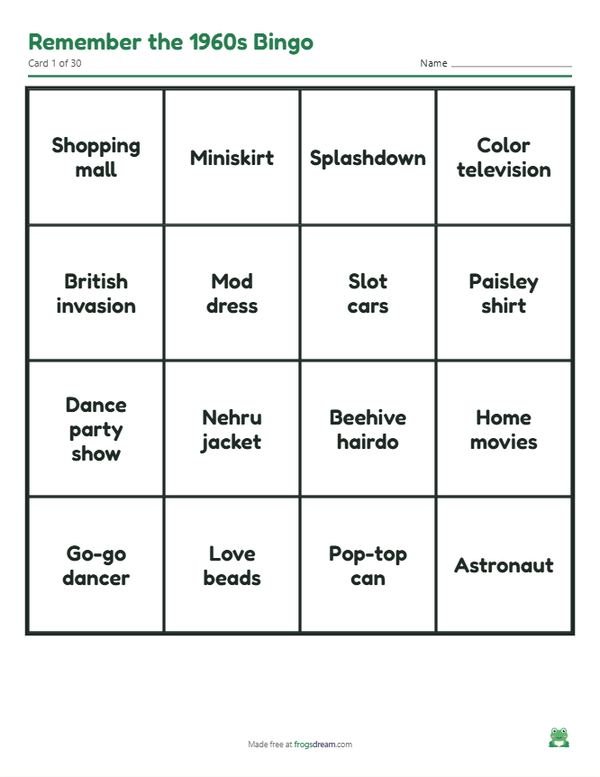
Print free large print bingo cards full of the 1960s: beehive hairdos, go-go boots, the twist, color television and the night the first people walked on the moon. One card per page, big words, and a caller sheet to read from.
Loading your preview...
Need 40 ready-made cards for every theme, plus caller sheets, in one download? Get the Mega Pack
The word list
The list runs from the early sixties of pillbox hats and the twist to the late sixties of tie-dye and the moon landing, so every resident finds their own years on the card. Remove anything that does not fit your group and add the dance hall or drive-in from your own town.
- Beehive hairdo
- Bouffant
- Pillbox hat
- Miniskirt
- Go-go boots
- Granny glasses
- Nehru jacket
- Paisley shirt
- Mod dress
- Fringe vest
- Love beads
- Tie-dye
- Flower power
- Peace sign
- Peace march
- Summer of Love
- Folk singer
- Coffeehouse
- Surf music
- British invasion
- Mop-top haircut
- The twist
- Mashed potato
- Go-go dancer
- Dance party show
- Color television
- Variety show
- Pop-top can
- Push-button phone
- Wall phone
- Long distance
- Zip code
- Trading stamps
- Shopping mall
- Supermarket
- Slide projector
- Home movies
- Instant camera
- Muscle car
- Convertible
- Surfboard
- Banana seat
- Slot cars
- Paint by number
- Astronaut
- Moon landing
- Splashdown
- Moon rocks
Running a sixties bingo afternoon
Many residents in assisted living today were teenagers or young parents in the sixties, so this list hits the years when they were buying their first car, raising babies or dancing at the weekend. Expect stories. Build the time for them into the session.
- Print the cards at one per page and hand each resident one card and a dauber. Keep the caller sheet for yourself.
- Read a square in a clear voice, wait, then read it again. Ask the table a question that goes with it, such as "Who learned to do the twist?" or "Where were you when the astronauts landed on the moon?"
- Give the room a minute to answer and to find the square. Residents who cannot see their card well can be helped by a neighbor or a volunteer.
- Keep a steady, unhurried pace. Around fifteen calls usually produces the first line on a 4 by 4 card.
- Check the winning card against your list, give a prize, and play on until two or three more people have a line.
Three ways to play it differently
- Clue bingo. Instead of saying the square, describe it. "A tall hairstyle held up with a can of hairspray" is the beehive. Residents guess, then mark. This is the version that gets the most laughs.
- Then and now. After each call, ask what replaced it. The wall phone became the cell phone, trading stamps became loyalty cards. It is a gentle way to bring in visiting grandchildren, who learn something too.
- Men's and women's lists. If your group is mostly men, lean the list toward cars, sports and the space program; for a mostly female group, add fashion and home squares. Edit the list in the box above and press Generate.
Tips for activity directors
Print your own copy of the caller sheet at a size you can read in a dim activity room, or put the online bingo caller on the TV in Projector mode and load this list. It shows each call in large type and keeps the called board visible for anyone who missed one.
Keep the mood light but do not shy away from the serious squares. The peace march and the moon landing were big parts of the decade, and residents often want to say where they stood on them. If a conversation turns heavy, thank the speaker and move to the next call.
For memory care groups, use 3 by 3 cards and call slowly, repeating each square three times. Covering squares is less important than talking about them, and our guide to running bingo for seniors has more on pacing and prizes.
Printing for low vision
The Large print box is ticked here, which locks the cards to one per page and prints the biggest words the generator can make on the 4 by 4 grid. Black ink on white paper gives the best contrast; if glare bothers your residents, cream paper works too.
Print thirty cards and keep the extras. Cards get coffee rings, and a resident who joins late appreciates a fresh one. Heavier paper or cardstock stands up to daubers better than copy paper.
FAQ
What makes this 1960s bingo different from a regular word bingo?
The squares are chosen to start conversations, not just to be found. Each one is something residents owned, wore or watched in the sixties, and the page prints one big card per sheet so the words are easy to read.
Will residents who grew up outside the United States recognize the squares?
Most of them. Miniskirts, the moon landing and color television reached nearly everywhere. Swap out squares that are purely American, such as zip codes or trading stamps, for items from your residents' home countries.
Can I use this list on the online caller?
Yes. Open the bingo caller, choose Custom words, and load the Remember the 1960s list from the themed menu. It calls the same squares that are printed on these cards.